
University catering
Five dining halls, fewer breakdowns, greater energy efficiency: how Studierendenwerk OstNiedersachsen controls its refrigeration intelligently
Together with Studierendenwerk OstNiedersachsen, the student services organisation for eastern Lower Saxony, we converted the commercial kitchen refrigeration at five university dining hall sites to self-learning control, from individual chilled rooms to interconnected freezer systems. The result: noticeably fewer unplanned breakdowns, lower energy costs and a measurable contribution to the operator’s sustainability goals.
5
dining hall sites with intelligent refrigeration
32
controlled cold and
freezer rooms
€34,714
lower breakdown costs
(10/2022–04/2025)
13,3 t
less CO₂ in
Jahr 2024
Project overview

STARTING POINT
- Five dining hall sites (Braunschweig Mensa 1 and 2, Wolfenbüttel, Clausthal,Hildesheim)
- 32 controlled cold and freezer rooms, plus 18 further monitored rooms, spread over several floors
- Refrigerants R449A, R134A, CO₂ (R744), R513A
- Time-based defrosting; various cold room controllers (Danfoss, Dixell, Eliwell)
- Icing at peak times and in summer, with costly knock-on failures

MODULES DEPLOYED
- Cold room monitoring (real-time sensors)
- Intelligent defrost control
- Intelligent room temperature control
- Anomaly detection and early fault detection
The challenge
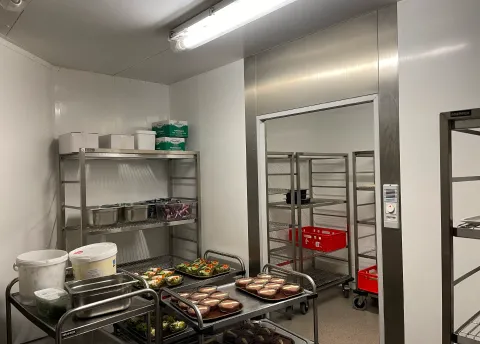
Many cold rooms, fluctuating loads, costly knock-on failures
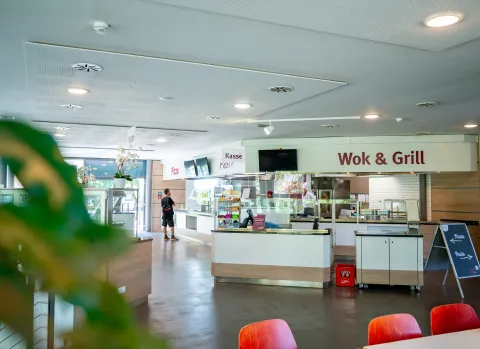
Commercial kitchen refrigeration in a university dining hall works differently from a central warehouse: many smaller cold and freezer rooms, separated for meat, vegetables, deliveries and daily use, often spread over several floors. At Studierendenwerk OstNiedersachsen, there is also the scale of five sites, each with its own plant technology and different cold room controllers.
On top of that, operations fluctuate heavily: at the lunchtime peak, doors open constantly and warm, humid air flows in, and in summer the refrigeration system is already running at its limit. Defrosting was time-based, following a fixed schedule regardless of the actual ice build-up on the evaporators. As a result, icing was detected late.
The following example shows how expensive this can become: under the high humidity load at peak times, the evaporators iced up faster than the time-based defrosting allowed for. The refrigeration system overloaded, the safety valve tripped, and refrigerant was lost and had to be refilled at considerable effort. Knock-on failures like this caused costs of around €68,700 between 2020 and 2022.
A further complication is that, as with many public-sector operators, refrigeration maintenance and repair work is largely carried out by external specialist contractors. The people responsible on site therefore need one thing above all: reliable data to understand breakdowns and take targeted countermeasures.
The solution
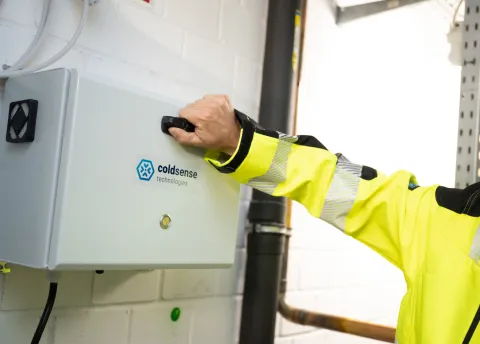
Intelligent refrigeration, custom-connected to the existing technology at each site
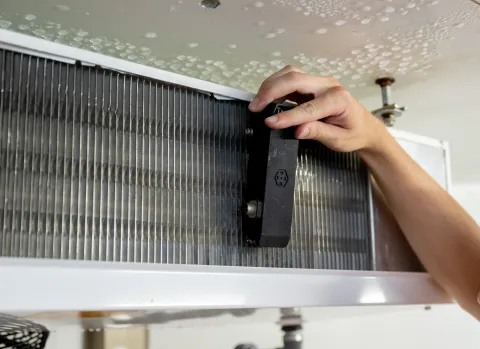
At each of the five sites, we installed our sensors and a Coldsense control unit that communicates with the existing refrigeration system. Ice, door and environmental sensors continuously record what is actually happening in each room. This data forms the basis for our AI-based refrigeration control. Machine learning identifies from the data the specific usage pattern and controls defrosting and temperature according to the situation. With demand defrost, the system defrosts when evaporator icing makes it necessary, not according to the clock. Unnecessary cooling demand on the compressors is reduced.
For a project of this size, compatibility with a range of existing equipment was crucial. Coldsense was connected to various cold room controllers, including Danfoss, Dixell and Eliwell. Our system is manufacturer-independent and could therefore be retrofitted across all sites, regardless of how each system was set up.
The installation was also planned around dining hall operations: the electrical work was carried out outside kitchen operating hours, on closing days, during holiday closures or after the kitchen closed from around 3 pm. As a result, ongoing dining hall and kitchen operations were never disrupted.
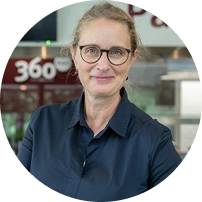

With the deployment of Coldsense Technologies' intelligent defrosting system in Mensa I, which we operate at TU Braunschweig, we have taken a big step forward in this regard. The data from the door movements of our cold room has helped us to better understand and optimize our operations. As a result, we have been able to reduce energy consumption in the cold rooms by 16%.

Results

Lower energy consumption and a smaller carbon footprint, measured with electricity meters
Across the sites evaluated in 2024, savings totalled 32,252 kWh and 13.3 tonnes of CO₂ per year.

Significantly lower breakdown costs
The largest single effect was seen at Mensa 1 in Braunschweig. With demand defrost and early anomaly detection, the knock-on failures previously caused by icing and tripped safety valves no longer occurred. Costs from technical breakdowns across several of the organisation’s sites fell from around €68,700 (2020–2022) to around €33,900 (10/2022–04/2025), a saving of just over €34,700.

Transparency that makes operations understandable
Across all sites, Coldsense provides continuous cold room temperature monitoring, records door and defrost behaviour and delivers monthly reports. This creates a data basis that is particularly helpful for assessing technical breakdowns and simplifies communication with external service providers. The door opening data has also proved valuable: it shows how much open doors drive energy consumption and gives the organisation a concrete basis for raising awareness among
kitchen staff.

More stable cold rooms in everyday operation
Beyond the measurable savings, operations have become noticeably calmer. The cold rooms run more evenly, and anomalies are detected and reported around the clock. Greater temperature stability in the cold rooms helps maintain the quality of the stored food.
Frequently asked questions about this project
How many sites and cold rooms does the project cover?
Coldsense controls the refrigeration at five dining hall sites of Studierendenwerk OstNiedersachsen: Braunschweig Mensa 1 and 2, Wolfenbüttel, Clausthal and Hildesheim. In total, 32 cold and freezer rooms are actively controlled, and further rooms are monitored. Each site has its own Coldsense control unit.
How is intelligent refrigeration implemented when several sites need to be covered?
First, each cold room is analysed individually and in combination with the building services. Based on this, the necessary sensors are installed. Fieldbuses act as relay stations and transmit the data to the Coldsense control unit, one of which is installed per site. It is manufacturer independent and was connected to various cold room controllers, including Danfoss, Dixell and Eliwell. The system is an add-on to the existing refrigeration system, with no need for a complete refit. The data collected is stored on servers located in Germany in order to regularly optimise the AI-based control.
Were dining hall operations disrupted during the installation of the intelligent refrigeration?
No. The electrical work was carried out outside kitchen operating hours, on closing days, during holiday closures or after the kitchen closed from around 3 pm. Ongoing dining hall and kitchen operations were never affected.
What was the strongest financial result of the intelligent refrigeration control?
At Studierendenwerk OstNiedersachsen, costs from technical breakdowns fell from around €68,700 (2020–2022) to around €33,900 (10/2022–04/2025). Previously, icing under peak load and the resulting tripped safety valves had repeatedly led to refrigerant losses and expensive service call-outs.