
Food and pharma logistics
More efficiency from your existing refrigeration system, without major investment
Refrigeration control with AI, retrofitted for temperature-controlled logistics: cold stores, cross-docking warehouses and pharma logistics
 Effective even on systems that are already optimised
Control in real time based on actual use, not fixed setpoints
For ammonia, CO₂ and glycol systems
What Coldsense achieves in your cold store
Improvements from our customers, measured and documented every month
15%
less energy, even on a state-of-the-art system
Measured at one of the largest CO₂ refrigeration systems in German logistics, which already uses warm brine defrosting.
24/7
stable operation
Less icing, less thermal stress, fewer unplanned shutdowns.
GDP-ready
unbroken cold chain
Temperature and humidity documented in an audit-proof way, for food and pharmaceuticals.
Several tonnes
less CO₂ per year
Reliable figures for ESG reporting and energy management under ISO 50001
The reality
In a cold store, refrigeration decides your margin
Temperature-controlled logistics for food and pharmaceuticals runs on tight margins and high energy costs. According to the VDKL, the German association of cold storage companies, refrigeration accounts for around 78% of a cold store’s energy demand. The association puts it bluntly: energy costs are eating the companies up.

No budget for a new system
Price pressure forces you to get more out of existing technology. Even modern systems leave potential untapped, because the timing of their control stays rigid

Utilisation fluctuates
the controls do not. Waves of trucks at the dock doors, warm goods, stock transfers. Whether ten doors or more than a hundred, the system follows fixed setpoints and defrost intervals.

Energy costs that follow the spot market
If you buy electricity on the spot market, you need precise control over when the refrigeration compressors run, for example during hot gas defrosting. Otherwise, unnecessary costs arise.
Why rigid refrigeration control costs money
Most refrigeration systems run at part load according to setpoints that were configured years ago. They do not respond to what is actually happening in the warehouse.
Every docking phase brings heat and moisture into the cold room. Warm goods first have to be cooled down and bring in additional moisture. At peak times these effects add up to load peaks that not only stress the system but also drive up the electricity bill.
The VDKL energy guide names the levers clearly: defrosting on demand instead of at fixed times, optimised part-load operation and active load management. In practice, these measures often fail for lack of control technology or specialist staff, which is why the guide recommends automation through external setpoint control.
The solution
Coldsense lowers your costs
Coldsense adds a self-learning control layer to your existing refrigeration system. Sensors capture icing, humidity, door openings and room conditions in real time. The AI learns your operating patterns and controls defrosting, temperature, suction pressure and energy flows according to actual demand. No intervention in the refrigeration hardware. No new system. Installed while operations continue.
The three key control modules

Cold room monitoring
Ice, door and environmental sensors capture what really happens in the room. The data foundation for efficient part-load operation

Smart defrost control
Defrost when there is ice, not when the clock says so. Explicitly recommended by the VDKL.

Smart room temperature control
Setpoints follow occupancy, door openings and the rhythm of goods movements, even when utilisation fluctuates sharply.
For NH₃ and CO₂ rack systems, suction pressure control is usually added straight away. Four further modules can be added: PV coupling, spot price optimisation, peak load management and the integration of other large consumers
Where Coldsense makes a difference
Where the leverage is greatest
Whether your system has a few hundred kilowatts or several megawatts of cooling capacity
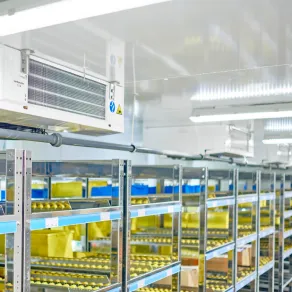
Frozen and chilled storage
The problem
Whether frozen storage at −20 °C with ammonia (NH₃) or CO₂ rack systems, or chilled storage with water and glycol: the cooling load fluctuates while the controls follow rigid setpoints. According to the VDKL, a frozen cold store uses an average of 45 kWh per cubic metre per year (2023 figures), and high goods turnover pushes this up by 15 to 25 kWh.
What Coldsense does
Defrosting, room temperature and suction pressure follow actual demand. Continuously, not as a one-off setting
15% savings at one of Germany’s largest CO₂ logistics systems, despite state-of-the-art warm brine defrosting
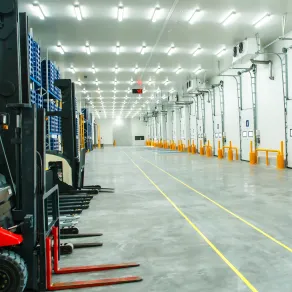
Cross-docking and transfer warehouses with truck docks
The problem
Cross-docking warehouses never rest. Warm goods, moisture ingress, waves of docking trucks. According to the VDKL, this high goods turnover is one of the biggest drivers of additional energy demand.
What Coldsense does
The control system recognises docking waves through sensors and the energy balance, and cools in advance instead of correcting afterwards.
Temperatures stay stable even under load: the system absorbs peaks instead of being driven by them.

Energy flow, spot prices and peak loads
The problem
Energy charges and capacity charges can be reduced, but only if the control system knows the energy flows of the entire site.
What Coldsense does
When spot prices are low or there is surplus solar power, the system cools in advance. During expensive hours, the refrigeration system stays off.
Depending on the goods and the system’s reserve capacity, the frozen store becomes thermal energy storage that lowers electricity costs and peak loads at the same time.
References
Temperature-controlled logistics relies on Coldsense
In technically comparable ammonia (NH₃) and rack systems, Coldsense achieves documented energy savings and more stable cooling processes


The refrigeration system is the heart of temperature-controlled logistics: it keeps our business alive. With Coldsense, we have a partner that uses artificial intelligence to make this core process more efficient than we ever could with manual control.


Vereinigte Eisfabriken & Kühlhallen, Vienna
A cooperative with more than 125 years of history. Food and pharmaceuticals down to −30°C, supplied from a central ammonia engine room.
- 16,000 pallet spaces
- 805 kWp PV
- 100% hydropower
The project is currently in its learning phase. Savings results will be published later
Return on investment and funding
Results from your existing system, with a manageable investment
Coldsense gets more out of your existing refrigeration system instead of replacing it. The investment stays manageable, and the impact on day to day operations is minimal. After commissioning, the AI spends around three months learning your operating patterns. Only then does it take over control and unlock the savings.
In addition to saving energy, Coldsense reduces two further cost blocks: capacitycharges, by capping load peaks, and the cost of purchased electricity, by shiftingconsumption to hours with low spot prices.
Funding
Many European countries support investments in energy efficiency, including measurement and control technology, through national programmes. Whether your project qualifies, and at what rate, depends on the country, the company and the measure. We work with specialist funding partners to find the right instrument for your site.
Frequently asked questions
How much energy can a cold store save with Coldsense?
That depends heavily on the condition of the system. For systems that have been optimised over many years, it may be a few percent; for others, considerably more. What matters is the absolute impact: since refrigeration accounts for around 78% of a cold store’s energy demand according to the German association VDKL, even a few percent add up to significant sums each year when electricity costs are high. The monthly report documents the actual results for each site.
Does Coldsense work with ammonia, CO₂ and glycol systems?
Yes. Coldsense works independently of the refrigerant: ammonia rack systems, CO₂ (R744) systems and water and glycol circuits for chilled areas. Coldsense does not replace the refrigeration system but sits on top of it as a control layer. At Vereinigte Eisfabriken in Vienna, Coldsense controls a central ammonia rack system that supplies around 16,000 pallet spaces.
Is Coldsense worthwhile if our system is already modern and energy optimised?
Yes. At one of the largest CO₂ refrigeration systems in German logistics, which already uses warm brine defrosting, Coldsense achieved savings of around 15%. The reason: even an efficient defrost method does not change the fact that defrosting usually follows rigid time intervals rather than the actual icing condition. The lever is not in the hardware but in the timing of the control.
Can we include Coldsense in an economic assessment under EN 17463 (VALERI)?
Yes. This European standard evaluates energy-related investments using the net present value method. Coldsense’s monthly reports provide the data basis: energy savings, CO₂ reduction and load profile. Because VALERI goes beyond a simple payback period and also takes non-monetary effects into account, the benefits can be captured more fully. The assessment itself is carried out by your energy auditors.
Does Coldsense support an unbroken cold chain for food and pharmaceuticals(GDP)?
Yes. Temperature and humidity are recorded continuously and documented in an audit-proof way. This supports an unbroken cold chain for food as well as the requirements of EU Good Distribution Practice in pharma logistics, for example for temperature-sensitive products such as blood plasma. Coldsense only optimises within your specified temperature limits: the cold chain always takes priority over energy savings.
How does using a frozen store as thermal energy storage work?
When spot prices are low or there is surplus solar power, Coldsense cools the room below its normal setpoint. The stored cold allows the system to be throttled back during expensive hours. How far this is possible depends on the goods and on the system’s reserve capacity: not every product tolerates a lower temperature.
How much effort does installation take, and when does Coldsense take effect?
The sensors are installed while operations continue and generally require no interruption to warehouse activity. The control unit communicates with your existing system controls. After installation, the AI spends around three months learning your usage patterns: door openings, goods movements and load profiles. Only then does it take over control.
What happens if the sensors or the control system fail?
The system automatically reverts to its original settings. Refrigeration keeps running without interruption; only the optimisation pauses temporarily. Sensor failures and anomalies are monitored around the clock. In the event of critical deviations, our service team gets in touch, including at night and at weekends.
Where can I find the VDKL figures quoted?
The VDKL is the German industry association for food companies in the temperature-controlled storage, distribution and logistics of frozen and fresh products. The figures quoted come from its guides at https://www.vdkl.de/infomaterial/ (in German).
Let’s check your savings potential
A few key facts about your system are all we need: refrigerant, cooling capacity, number and type of cold rooms, and existing energy infrastructure. You will receive an initial assessment within one working day.