
Canteens & institutional catering
Fewer malfunctions and lower energy costs in your commercial kitchen
Refrigeration control with AI, retrofitted for university canteens, staff restaurants and institutional catering
 Cold chain secure and fully documented
Control in real time based on actual use, not fixed setpoints
Proven at five university canteens of Studierendenwerk OstNiedersachsen
What Coldsense achieves in your kitchen
Four improvements, measured and documented every month
€34,714
lower costs
Studierendenwerk OstNiedersachsen: down from €68,663 (2020 to 2022) to €33,948 (10/2022 to 04/2025).
32,252 kWh
less electricity peryear
10 to 22% per site, measured at four canteens in 2024.
13.3 tonnes
less CO₂ per year
Energy savings plus avoided refrigerant loss
Compliant coldchain
fully documented
Temperatures recorded continuously in line with national quality standards, so compliance records are easier to keep.
The reality
In a commercial kitchen, refrigeration runs around the clock, and often inefficiently.
In university canteens, staff restaurants and institutional catering, refrigeration is a silent workhorse: several walk-in cold rooms and freezers, separated for meat, vegetables, deliveries and daily use, often spread over two floors. Together they are among the largest electricity consumers in the building, and among the few that hardly anyone monitors in detail.

Many small rooms, none of them monitored
Instead of one large system, there are many separate rooms with different uses. There is simply no time for manual optimisation.

Operations fluctuate, the controls do not
At the lunchtime peak, doors open every minute. In quiet periods the load drops, but the system keeps cooling as if it were peak time.
The cold chain is non-negotiable
Food hygiene law sets strict maximum temperatures for chilled food and requires an unbroken frozen chain. Savings must never come at the expense of food safety.
The trade-off, and how it is resolved
Most systems follow fixed setpoints and rigid defrost intervals that were set years ago. They do not know whether it is peak time or reduced operation, whether a door is open or an evaporator is already iced up. Defrosting happens by the clock, not by condition.
Refrigeration is under the most pressure in summer. Warm, humid outside air makes evaporators ice up faster, and the system works at its limit. Under this load, unnoticed icing can turn into a real malfunction, up to system failure and the loss of stored food.
At the same time, the cold chain is backed by law: EU food hygiene law (Regulation (EC) No 852/2004) requires HACCP-based controls, and national rules set maximum temperatures for chilled food. Energy is under scrutiny too. The EU green public procurement criteria for catering address energy use in kitchens, and under the EU Energy Efficiency Directive, public bodies must cut their total final energy consumption by at least 1.9% a year compared with 2021.
This is the apparent trade-off: keeping food safely cold while still saving energy. Rigid controls can only reliably deliver one of the two. Self-learning control reduces consumption where there are reserves, without touching the cold chain.
The solution
Refrigeration control that thinks ahead.
Coldsense adds a self-learning control layer to your existing refrigeration system. Sensors capture icing, door openings and room conditions in real time. The AI learns the rhythm of your kitchen and controls defrosting and temperature according to actual demand, room by room.
No intervention in the refrigeration hardware. No new system. Compatible with all leading refrigeration controllers.
The three key control modules

Cold room monitoring
Ice, door and environmental sensors capture what really happens in the room, including how long doors stay open.

Smart defrost control
Defrost when there is ice, not when the clock says so. The biggest direct savings lever.
Smart room temperature control
Setpoints follow occupancy and door openings, always within the required temperature limits.
In university canteens and large kitchens, these three modules are almost always the starting point. Five further modules can be added, such as PV coupling, peak load management or the integration of other large consumers.
Where Coldsense makes a difference
Where the leverage is greatest
Wherever refrigeration runs around the clock and conditions in the room fluctuate sharply.
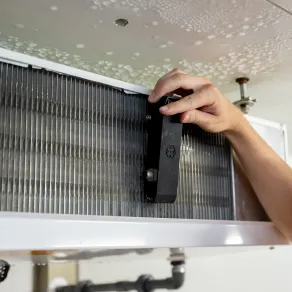
Walk-in freezers and freezer cells
The problem
Evaporators ice up continuously and are defrosted on a fixed schedule, regardless of actual ice build-up. That costs twice: energy for unnecessary defrosting, and heat that the system then has to remove again.
What Coldsense does
- Defrosting follows the measured icing condition.
- 81 to 91% less defrosting effort at the sites evaluated (2024)
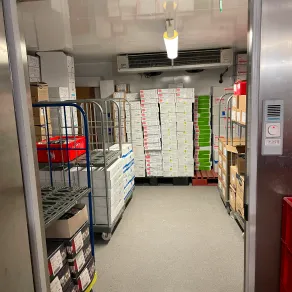
Walk-in cold rooms in the kitchen
The problem
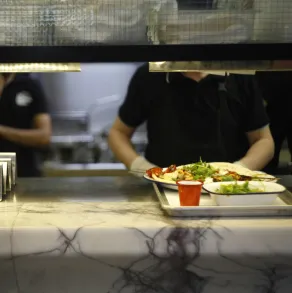
At the lunchtime peak, doors open constantly and warm, humid air flows in. This moisture drives icing and consumption, and a timer-controlled system cannot respond to it.
What Coldsense does
- Door openings, temperature and ice build-up are measured continuously. This shows where excess consumption arises
- 9,421 hours of measured door opening time per year: a concrete basis for raising awareness among kitchen staff
Cook & chill and blast chilling
The problem
Freshly cooked food must be chilled immediately and kept safely cold until it is reheated. Cooling demand comes in bursts and is high.
What Coldsense does
The control system recognises the batch rhythm and reliably maintains the required temperatures for chilling and cold storage
References
University catering and large canteens rely on Coldsense
Many smaller walk-in cold rooms and freezers instead of one large system, plus occupancy that varies sharply over the day, the week and the semester. Coldsense controls systems like these at five university canteens of Studierendenwerk OstNiedersachsen, the student services organisation for eastern Lower Saxony: from a single standard cold room to an interconnected freezer system. What works at one site can be rolled out across the whole organisation.

With the deployment of Coldsense Technologies' intelligent defrosting system in Mensa I, which we operate at TU Braunschweig, we have taken a big step forward in this regard. The data from the door movements of our cold room has helped us to better understand and optimize our operations. As a result, we have been able to reduce energy consumption in the cold rooms by 16%.


Studierendenwerk OstNiedersachsen
Five university canteens: Braunschweig Mensa 1 and 2, Wolfenbüttel, Clausthal and Hildesheim.
- 32,252 kWh saved (2024, four sites evaluated)
- 13.3 t less CO₂
- €34,714 lower costs
Return on investment and funding
An investment that pays off in more than one way
Coldsense reduces running costs twice over: lower energy consumption and fewer unplanned malfunctions with their follow-on costs. After a learning phase of around three months, these savings take effect continuously. How quickly the investment pays for itself depends on system size, electricity price and usage patterns. We prepare a reliable estimate based on your technical documentation.
Coldsense delivers the figures you need for this: consumption, temperature and defrost data, broken down by room and module, in monthly reports. This also supports an existing energy management system under ISO 50001.
Public sector targets and funding
For canteens run by universities, hospitals and public authorities, the EU Energy Efficiency Directive sets a clear target: public bodies must reduce their total final energy consumption by at least 1.9% a year. Coldsense contributes measured, documented savings to this. Many EU countries also support energy efficiency investments through national programmes. Whether your project qualifies depends on the country, the type of organisation and the measure.
We work with specialist funding partners to find the right funding options for you.
Frequently asked questions
How much energy does Coldsense save in a university canteen or staff restaurant kitchen?
Savings depend on the system, its starting condition and the modules chosen. At the four evaluated sites of Studierendenwerk OstNiedersachsen, savings in 2024 ranged from around 10 to 22% per site, totalling 32,252 kWh and 13.3 tonnes of CO₂. The savings take effect continuously after a learning phase of around three months.
Does Coldsense also reduce malfunctions, not just energy consumption?
Yes. Early anomaly detection and defrosting on demand prevent consequential damage such as icing under peak load. At Studierendenwerk OstNiedersachsen, costs from technical breakdowns fell from €68,663 in 2020 to 2022 to €33,948 from October 2022 to April 2025, a saving of €34,714.
Is Coldsense compatible with food safety standards and the cold chain?
Yes. Coldsense works within the required temperature limits and only optimises when and how they are reached. The legal basis is EU food hygiene law (Regulation (EC) No 852/2004) with HACCP-based controls, complemented by national temperature limits for chilled and frozen food. Coldsense records and documents temperatures continuously, which makes compliance records easier.
How much effort does installation take in a working kitchen?
The sensors are not installed during service, but after the kitchen closes, on rest days or during holiday closures. For hygiene reasons, electrical work during kitchen operation would not be acceptable. Depending on scope, installation takes a few days and can be scheduled around periods when the kitchen is closed anyway.
How quickly does the system take effect after installation?
After installation, the AI spends around three months learning how your rooms are used before it takes over control. Only then do the savings begin, but from that point on they continue.
Is Coldsense worthwhile with several smaller cold rooms?
Yes. University canteens, staff restaurants and institutional catering operations typically run many smaller walk-in cold rooms and freezers with different uses. Coldsense controls each room individually according to its actual demand and shows, comparably across all rooms, where excess consumption arises.
What happens if the sensors or the control system fail?
The system automatically reverts to its original controls. Refrigeration keeps running without interruption; only the optimisation pauses temporarily. Anomalies are continuously monitored and reported.
Let’s check your savings potential
A few key facts about your system are all we need: number and type of cold rooms and freezers, refrigerant, approximate electricity consumption and existing energy infrastructure. You will receive an initial assessment within one working day.