
Food wholesale
Up to 50% less energy in your cold rooms
Refrigeration control powered by AI, retrofitted for food wholesale: frozen storage, chilled storage and incoming goods
 Works with your existing refrigeration system
Control in real time based on actual demand, not the clock
Payback typically in under five years
What Coldsense delivers in food wholesale
Validated results from customer projects, measured and documented every month:
17 to 50%
lower energy consumption
17% in frozen storage at EBÄKO, more than 50% in one frozen store at Gilde Mitte Nord.
up to 90%
more stable temperatures
Delivery commitments hold, even under peak load. Reliable cold chain documentation.
67.9%
of defrosting powered by your own solar
Less grid power, fewer load peaks.
48.4 tonnes
less CO₂ per year (3 sites)
Achieved at EBÄKO. Robust figures for ESG reporting and ISO 50001.
The reality
Reliable delivery depends on reliable cold
Your business runs on 24-hour promises. What is ordered in the evening must reach the customer the next morning with the cold chain unbroken. Behind that are frozen and chilled stores, loading docks with constant door openings, and waves of trucks that pull energy out of your cold rooms every night.

The largest cost block.
Refrigeration accounts for up to 85% of electricity consumption. Every percentage point goes straight to your margin

Systems that have grown over time.
Multiple standalone units, different control generations, refrigerants covered by the F-gas Regulation, defrosting on a fixed schedule.
Peak loads cost twice.
Truck loading, intralogistics and refrigeration draw power at the same time. That drives up both energy and capacity charges.
Where energy is lost unnoticed
Standard measures such as air curtains, high-speed doors and demand defrost have long been in place at many sites. Even so, the refrigeration system uses more energy than necessary in daily operation, for three reasons:
First, defrosting. Timed cycles defrost even when there is no ice. Every unnecessary defrost warms the room, which then has to be cooled down again.
Second, solar power. Midday PV power is exported to the grid at poor rates instead of being stored on site as cold.
Third, peak loads. When several large consumers start at once, the resulting demand peak drives up grid capacity charges. Your control system takes no notice.
The solution
Refrigeration control that thinks ahead
Coldsense adds a self-learning control layer to your existing refrigeration system. Sensors capture evaporator icing, door openings and room conditions in real time. The AI learns your operating patterns and controls defrosting, temperature and energy flows according to actual demand.
No intervention in the refrigeration hardware. No new system. Installed while operations continue, and if you replace the system later, the control layer moves with it.
The three starter modules:

Cold room monitoring
Ice, door and environmental sensors capture what really happens in the room. The data foundation for everything else.

Smart defrost control
Defrost when there is ice, not when the clock says so. With electric defrost, this is the biggest savings lever.

Smart room temperature control
Setpoints follow occupancy, door openings and goods flow, across multiple rooms with different utilisation.
In food wholesale, these three modules are almost always the starting point. Where a PV system is in place, PV coupling is usually added straight away. Five further modules can be added, such as suction pressure control for rack systems, spot price optimisation or peak load management.
Where Coldsense makes a difference
Where the leverage is greatest
Wherever commercial and industrial cold rooms run around the clock and conditions fluctuate sharply.
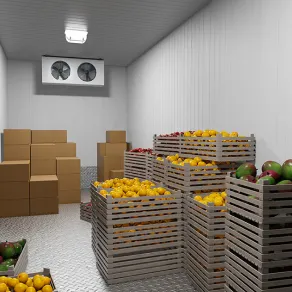
Frozen and chilled storage
TK-Lager und Frischelager
The problem
Frequent door openings during order picking, moisture ingress with every opening, constant icing. Most systems defrost on a timer, even when there is no ice.
What Coldsense does
Defrosting follows measured ice build-up instead of a schedule.

EBÄKO
17% less energy in frozen storage

Gilde Mitte-Nord, April 2026
50.4% savings in one frozen store
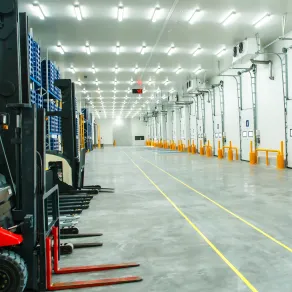
Incoming goods, outgoing goods and loading docks
TK-Lager und Frischelager
The problem
Every truck that docks brings heat and moisture into the cold room. When several trucks dock at night, the effects add up to peak loads.
What Coldsense does
The control system recognises docking waves and cools ahead oftime instead of correcting afterwards.
EBÄKO
At EBÄKO, a dedicated precooling module is currently being developed that activates before the trucks arrive.
Gilde Mitte-Nord
- 20.9% less energy
- 70% fewer defrost hours in the loading dock
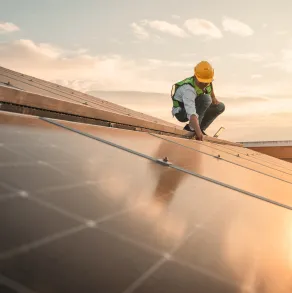
PV, peak loads and energy flow
TK-Lager und Frischelager
The problem
Solar power is exported at midday instead of being used. In the morning and evening, costly peaks occur when several large consumers start at once.
What Coldsense does
Defrosting and cold storage shift to hours with strong solar output.The refrigeration system buffers peak loads from other consumers.
Gilde Mitte-Nord
- 67.9% of defrost energy from surplus solar (Gilde Mitte-Nord)
- Grid share for cold storage down from 46.4% to 36.0%
References
Food wholesalers rely on Coldsense




We knew that refrigeration was our biggest energy consumer across all our sites. What we hadn’t realised was how much energy goes into defrosting, and how easily it can be reduced.

EBÄKO eG
What began in Braunschweig and Oldenburg now runs at three branches.
- 120,786 kWh saved per year
- 48.4 t less CO₂
- 3 sites
Return on investment and funding
Payback in under five years, with up to 45% funding in Germany
Coldsense optimises your existing system instead of replacing it. The investment stays manageable, and installation takes place during normal operations. After a learning phase of around three months, the AI takes over control of your system. From then on, the savings accrue continuously.
In food wholesale, typical payback periods without additional funding are under five years, and significantly shorter at sites with high energy use. They depend on system size, electricity price and choice of modules.
Up to 45% BAFA grant in Germany
In Germany, Coldsense qualifies as measurement and control technology under the Federal Funding for Energy and Resource Efficiency in the Economy (EEW), typically under Module 3, with investment grants of up to 45% for SMEs.
Comparable programmes exist in Austria and Switzerland. Our funding partners identify the right instrument for your site and take care of the application and reporting.
FAQ
How much energy can AI refrigeration control save in food wholesale?
In frozen and chilled storage, savings typically range from 17 to 50% in monthly measurements. The level depends on system type, starting condition and choice of modules. At EBÄKO, energy consumption in frozen storage fell by 17%. At Gilde Mitte-Nord, one frozen store achieved energy savings of 50.4% in April 2026. Even higher values can be measured in blast freezing rooms.
Is Coldsense worth it if our system has to be replaced anyway under the F-gas Regulation?
Yes, especially then. Switching to a CO₂ (R744) system makes sense in the long term, but it is a six- to seven-figure investment. Until then, Coldsense cuts the energy consumption of your existing system by 10% or more. Sensors and control logic can be transferred to the new system after the replacement, so the investment is not lost. It moves with you.
Does Coldsense work across multiple sites at the same time?
Yes. A configuration proven at one site becomes the blueprint for further branches, adapted to their systems, refrigerants and energy infrastructure. EBÄKO eG started in Braunschweig and Oldenburg and now runs Coldsense at three branches. Each site receives its own monthly reports, and the results remain comparable.
Can Coldsense manage peak loads and take truck deliveries into account?
Yes. Coldsense records the load profiles of refrigeration, truck loading, intralogistics, production and other large consumers, as well as PV systems and CHP units. On this basis, the refrigeration system buffers peak loads, stores surplus solar power as cold and cools loading areas in advance before the trucks arrive. At Gilde Mitte-Nord, 67.9% of defrost energy was covered by surplus solar in April 2026, and the grid share for cold storage fell from 46.4% to 36.0%.
How much effort does the retrofit take while operations continue?
Installation takes place during normal operations and generally requires no interruption to warehouse activity. Ice, door and environmental sensors are mounted on the evaporator, the doors and in the room. The control unit communicates with your existing system controls and only intervenes actively after the learning phase, which takes around three months.
Is Coldsense compatible with our refrigerant?
Yes. Coldsense works independently of the refrigerant and is compatible with the synthetic refrigerants common in wholesale, such as R449A and R404A, with CO₂ (R744) systems and with rack systems. Coldsense does not replace the refrigeration system but connects to it as a control layer. At EBÄKO, Coldsense controls systems with different refrigerants and control generations.
Does Coldsense support ISO 50001 and IFS Logistics requirements?
Yes. The monthly reports provide energy, temperature and CO₂ figures that can be used directly in energy management systems under ISO 50001. Continuous temperature documentation supports the requirements for an unbroken cold chain. EBÄKO eG is ISO 50001 certified and uses Coldsense data as part of its energy management.
What happens if the sensors or the control system fail?
The system automatically reverts to its original settings. Refrigeration keeps running without interruption; only the optimisation pauses temporarily. Sensor failures and anomalies are monitored around the clock. In the event of critical deviations, our service team gets in touch, including at night and at weekends.
Let’s check your savings potential
A few key facts about your system are all we need: cold room size, refrigerant, existing energy infrastructure and number of sites. You will receive an initial assessment within one working day.